
Whitepaper: Beyond Delivery - How Agentic AI is Transforming Industry Processes

Established in 1964, ECH is a not-for-profit organisation and is one of the largest integrated providers of retirement village accommodation and care services in South Australia.
Executive Summary
For organisations under pressure to do more with constrained resources, the next phase of AI adoption moves beyond personal productivity. Its greater strategic value lies in transforming industry processes: the core end-to-end workflows that determine whether services are delivered reliably and at scale. Organisations that fail to redesign core processes will increasingly underperform peers adopting agentic models in the workflows that shape cost, speed, resilience, and service outcomes. The question for CEOs and executive teams is no longer whether AI can save time, but whether the organisation can rapidly align governance, ownership, data, and change leadership behind the processes where better decisions would materially improve performance.
This paper argues that process transformation of this kind depends on five disciplines. Executive teams must:
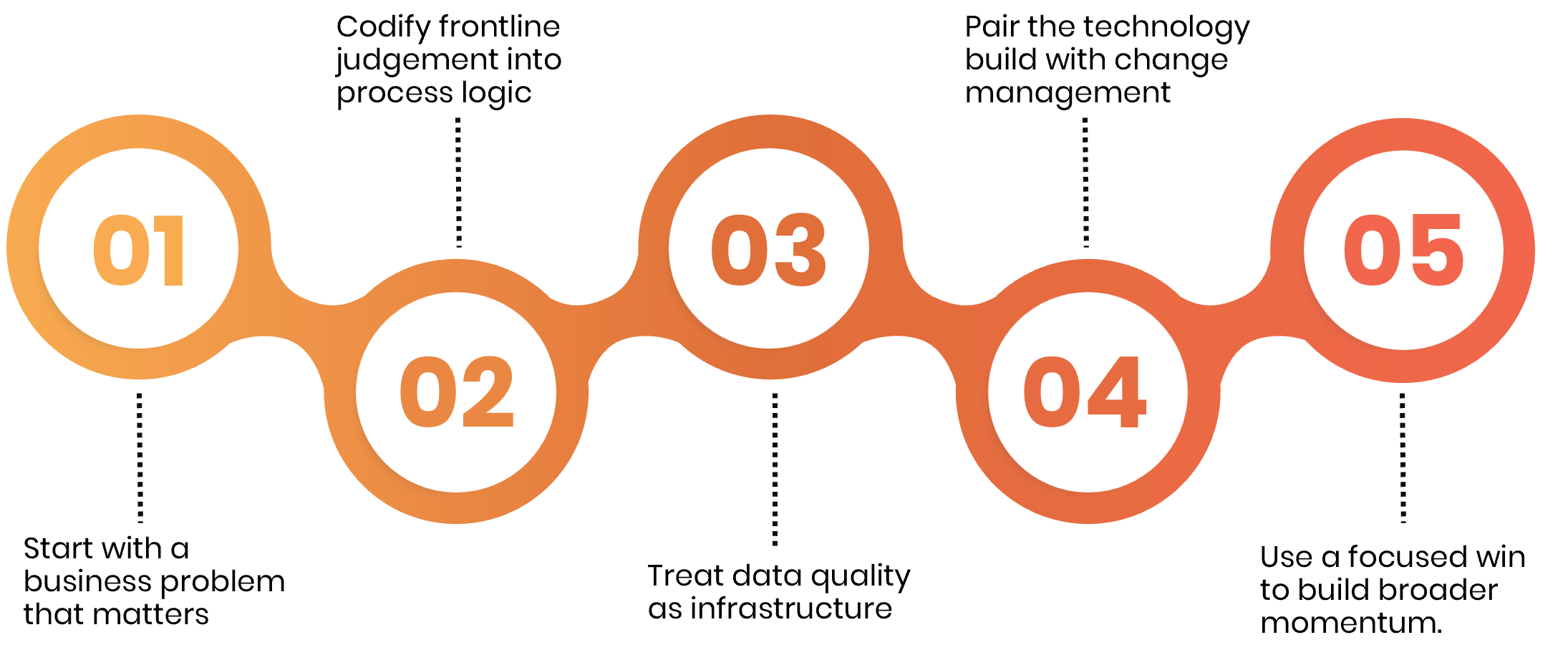
Together, these disciplines separate process changes that strengthen performance from pilots that remain peripheral.
ECH’s implementation of Schedtris shows what this looks like in practice. Deployed within ECH’s Microsoft Azure environment, Schedtris helps schedulers identify the best replacement options when unplanned absences occur by reasoning across worker skills, location, continuity, travel time, and availability with live data stored in AlayaCare. The result has been the redesign of a critical industry process shared across the aged care sector. With rescheduling time reduced by over 50% and 15 hours of scheduling capacity recovered each week, operational efficiency has translated into ECH’s clients receiving more consistent and reliable services.
In doing so, ECH shows how a process long treated as an unavoidable operational burden can be redesigned to improve workforce stability and service delivery. This paper places ECH alongside examples where organisations are using the same underlying disciplines to redesign processes unique to their respective industries. Hence, the executive question: If redesigned now, which core process wouldmaterially change organisational performance, and how quickly can you act on it?

The benefits extend across the entire care pipeline. Schedulers aren’t immediately putting out fires at the beginning of their day. Support workers get earlier notice when their day changes, which makes a significant difference to their satisfaction and retention. And clients are more likely to be matched with workers they already know and trust, directly increasing their continuity of care”
-Sharon Paulson, Head of Digital Workplace Services, ECH

Microsoft Elevate is grounded in a simple belief: when we put people first, technology becomes a force multiplier for social impact. Working alongside organisations like ECH, we are exploring how AI can support the delivery of critical human services, enhancing real-time decision-making, strengthening operational resilience, and ultimately enabling more responsive and equitable outcomes at scale.
-Anita Sood, Microsoft Asia Elevate Commercial Lead